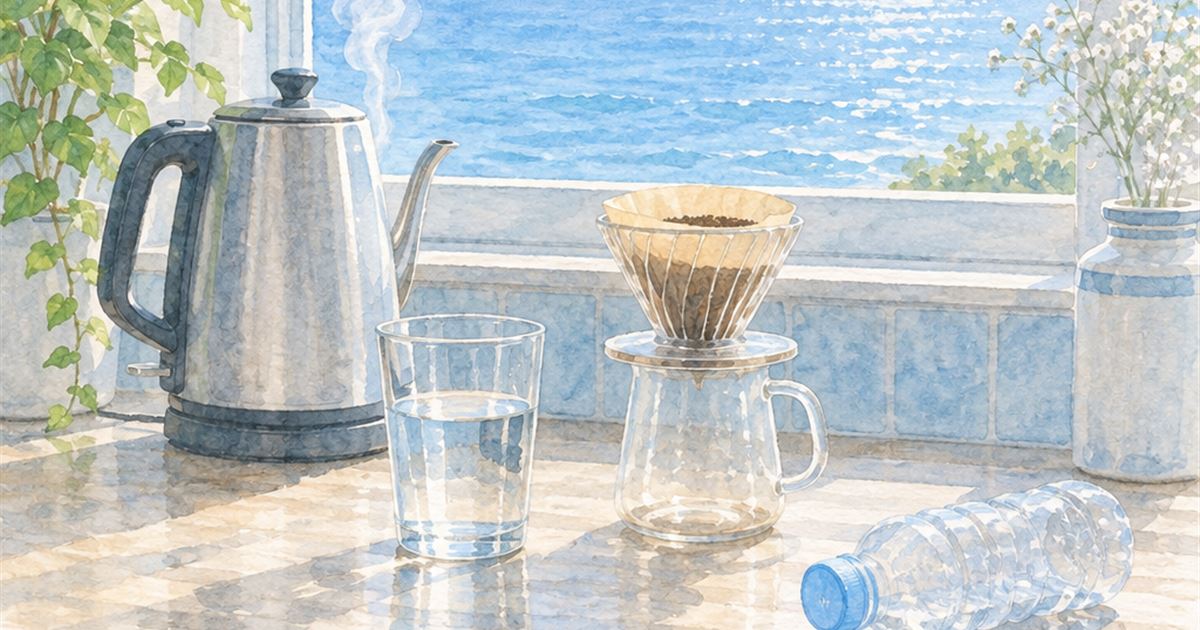
생수 미세플라스틱, 끓이면 줄어들까? 연구로 확인한 것
생수를 사 마시다 보면 "이 안에 미세플라스틱이 있다던데" 하는 기사가 눈에 띄죠. 그럼 끓이면 괜찮을까요? 연구로 확인된 것과 아직 모르는 것을 나눠서 정리했어요.
생수 한 병에 플라스틱 조각이 얼마나 있을까
미국 연구진이 2024년 1월 학술지 PNAS에 발표한 연구는 새로운 레이저 현미경 기술로 생수 속 아주 작은 플라스틱 조각을 세었어요. 시중에서 판매되는 생수 3개 제품을 분석했더니, 1리터에 평균 약 24만 개(11만~37만 개)의 조각이 있었고 그중 약 90%는 나노플라스틱(1마이크로미터보다 작은 조각)이었어요. 미국 국립보건원(NIH)은 이 수치가 이전 연구보다 10~100배 많다고 소개했어요.
- 이전 연구는 주로 더 큰 미세플라스틱만 세었기 때문에 숫자가 훨씬 작았어요.
- 분석한 제품은 미국에서 파는 3개뿐이라서, 다른 나라 제품에 그대로 적용하기는 어려워요.
끓이면 줄어든다는 연구, 그런데 수돗물 이야기예요
2024년 2월 학술지 Environmental Science & Technology Letters에 실린 중국 연구진의 연구는 수돗물을 끓이는 실험이었어요. 연구진이 수돗물에 일부러 미세플라스틱을 넣고 5분 끓인 뒤 식혔더니, 칼슘이 많은 센물(경도 120mg/L 초과)에서는 크기 0.1~150마이크로미터 입자가 80% 이상 줄었어요. 물이 끓을 때 생기는 석회 결정이 플라스틱 조각을 감싸 가라앉기 때문이에요.
- 석회 성분이 많을수록 효과가 컸고, 경도 300mg/L 물에서는 최대 약 90%가 제거됐어요.
- 석회가 적은 단물(60mg/L 미만)에서는 약 25%만 줄었어요.
- 끓인 뒤 식혀서 거르는 과정이 함께 필요했어요.
이 연구는 생수를 다루지 않았어요. 생수는 제품마다 미네랄 성분이 달라서 같은 결과가 나온다고 말할 수 없고, 우리 집 수돗물에서 어떨지도 이 연구만으로는 알 수 없어요.
건강에는 어떨까: 확인된 것과 아직 모르는 것
세계보건기구(WHO)는 2019년 보고서에서 제한된 자료로 볼 때 지금 수준의 마시는 물 속 미세플라스틱은 건강 위험으로 보이지 않는다고 밝혔어요. 150마이크로미터보다 큰 입자는 몸에 흡수되기 어렵고, 더 작은 입자의 흡수도 제한적일 것으로 봤어요.
- 확인된 것: 마시는 물에서 미세플라스틱이 발견되고, 생수에서 입자 수가 더 많이 보고됐어요.
- 아직 모르는 것: 나노 크기 입자가 몸에 어떤 영향을 주는지는 자료가 매우 부족하다고 WHO가 밝혔어요. 더 많은 연구가 필요하다는 입장이에요.
WHO 보고서는 생수병은 보통 PET로, 뚜껑은 PP나 PE로 만든다고 설명해요. 병과 뚜껑이 어디서 온 조각인지 연구가 계속되고 있어요.
직장인이 할 수 있는 작은 습관
건강 영향이 분명하지 않아도, 플라스틱을 덜 쓰는 일은 바다에도 도움이 돼요. 무리하지 않는 선에서 해 보세요.
- 매번 사 마시는 생수 대신 텀블러에 정수기 물이나 수돗물을 담아 다녀요.
- 수돗물을 끓여 마신다면, 끓인 뒤 식혀서 가라앉은 석회를 거르는 방법이 연구에서 효과가 있었어요. 다만 물의 센 정도에 따라 달라요.
- 다 쓴 페트병은 라벨을 떼고 깨끗이 헹궈 분리배출해요.
My Little Sea에서 바다 쓰레기를 떠올려 보기
우리가 버린 플라스틱은 잘게 부서져 결국 바다로 가요. 해양쓰레기 도감에서 어떤 쓰레기가 얼마나 오래 남는지 볼 수 있고, 내 하루 플라스틱 계산기로 내 하루를 가볍게 돌아볼 수도 있어요. My Little Sea에서 화면 속 바다의 쓰레기를 치우며 현실의 바다도 한 번 떠올려 보세요.
If you drink bottled water, you have probably seen headlines about microplastics inside it. Does boiling fix that? Here is what research has confirmed and what is still unknown.
How Many Plastic Pieces Are in a Bottle of Water?
A study published in January 2024 in PNAS by US researchers used a new laser microscopy method to count tiny plastic pieces in bottled water. In three popular products, a liter contained about 240,000 pieces on average (110,000 to 370,000), and about 90% were nanoplastics, smaller than one micrometer. The US National Institutes of Health (NIH) noted that this was 10 to 100 times higher than earlier studies.
- Earlier studies mostly counted only larger microplastics, so their numbers were far smaller.
- Only three products sold in the US were tested, so the numbers cannot simply be applied to products elsewhere.
Boiling Reduces Plastics, but the Study Was About Tap Water
A study by Chinese researchers published in February 2024 in Environmental Science & Technology Letters boiled tap water. The team spiked tap water with microplastics, boiled it for five minutes and let it cool. In hard water (above 120 mg/L of calcium carbonate), at least 80% of particles between 0.1 and 150 micrometers were removed, because limescale crystals that form as the water heats wrap around the plastic.
- The harder the water, the better it worked: up to about 90% removal at 300 mg/L.
- In soft water (below 60 mg/L), only about 25% was removed.
- The cooled water also had to be filtered.
This study did not test bottled water. Minerals differ by product, so the same result cannot be assumed, and it cannot tell us how your own tap water would perform.
What About Health: Confirmed and Still Unknown
In its 2019 report, the World Health Organization (WHO) said that, based on limited information, microplastics in drinking water do not appear to pose a health risk at current levels. It said particles larger than 150 micrometers are unlikely to be absorbed, and uptake of smaller particles is expected to be limited.
- Confirmed: microplastics are found in drinking water, and higher particle counts were reported in bottled water.
- Still unknown: WHO said information on the effects of nano-sized particles is extremely limited and more research is needed.
The WHO report notes that bottles are often made of PET and caps of PP or PE. Research on where the pieces come from is continuing.
Small Habits for Busy Workers
Even if health effects are unclear, using less plastic helps the ocean. Do what is easy for you.
- Instead of buying bottled water every time, carry a tumbler filled with water-purifier or tap water.
- If you boil tap water, letting it cool and filtering out the settled limescale worked in the study, though results depend on how hard the water is.
- Remove the label, rinse used PET bottles and recycle them.
Thinking About Ocean Trash in My Little Sea
Plastic we throw away breaks into small pieces and often ends up in the sea. Our Trash Guide shows how long different kinds of waste last, and the Daily Plastic Calculator lets you look at your own day. While you clear the trash from your little sea in My Little Sea, take a moment to think about the real ocean too.
나만의 작은 바다, 직접 가꿔볼까요?
쓰레기를 치우고 수초와 산호를 심어 물고기를 키우는 힐링 게임 My Little Sea. 잔잔한 파도 소리와 함께 하루 끝에 물멍 한 스푼.
Clean up the trash, plant seaweed and coral, and raise fish in My Little Sea, a relaxing ocean game. Unwind at the end of the day with calm wave sounds.
참고 자료
- PNAS (2024), Rapid single-particle chemical imaging of nanoplastics by SRS microscopy
- NIH Research Matters, Plastic particles in bottled water
- Environmental Science & Technology Letters (2024), Drinking Boiled Tap Water Reduces Human Intake of Nanoplastics and Microplastics
- American Chemical Society, Want fewer microplastics in your tap water? Try boiling it first
- WHO (2019), Microplastics in drinking-water
- WHO (2019), WHO calls for more research into microplastics and a crackdown on plastic pollution
- 대표 이미지는 AI로 생성했어요. (Cover image generated with AI.)